AWS DevOps & Developer Productivity Blog
Category: Artificial Intelligence
Building a Slack-powered AI development agent with Kiro CLI and headless authentication
Every code review discussion, incident response thread, and standup happens in Slack. But when an engineer needs to analyze a service or debug a failing test, they leave Slack, open a terminal, navigate to the repository, run commands, and paste the output back. That round trip takes 30 seconds for someone who knows exactly where […]

Accelerating development workflows with Kiro CLI as a Pre-Commit and Git Hook Agent
Code review feedback is most valuable when it arrives early. A security vulnerability caught in a pull request saves hours. The same vulnerability caught in production costs days. But what if you could catch it before the code even leaves the developer’s machine – at the time of git commit? Git hooks run automatically at […]
Audit trails for autonomous agents with AWS DevOps Agent
AWS DevOps Agent investigates production incidents and proposes or applies fixes on your behalf, raising two questions for every operation and security review: what did the agent do, and how do you understand its impact? Learn how to build a durable, low-maintenance audit trail using the agent journal, Amazon EventBridge lifecycle events, and AWS CloudTrail.
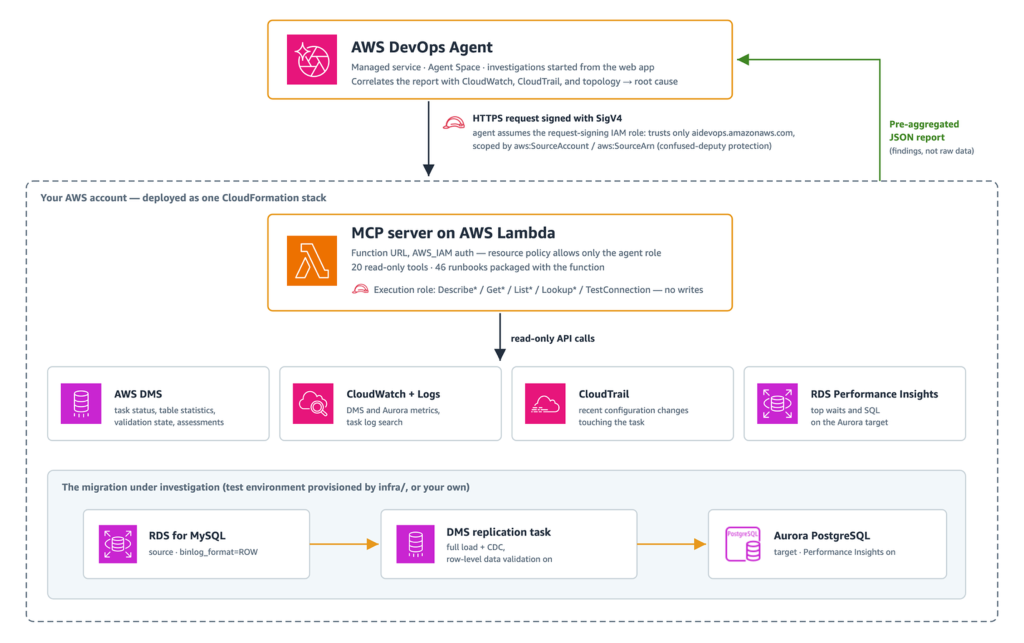
Investigate DMS migration issues with AWS DevOps Agent
Migrating a production database is a high-risk operational event. AWS DMS is a cloud service that migrates relational databases, data warehouses, and other data stores into the AWS Cloud or between environments. It moves the rows reliably, but the failures that page an on-call engineer rarely happen during the data copy. They occur in the […]
Automating the Experimentation Lifecycle with Kiro, AWS DevOps Agent, and LaunchDarkly
Introduction Continuous improvement depends on experimentation. Teams know that the fastest path to better outcomes is to test changes against real user behavior, measure results, and iterate. In practice, sustaining that cycle is slow and costly because the overhead compounds with each attempt. Three barriers slow teams down: 1. Planning cost — Turning a proposed […]
Automate planned lifecycle upgrades with AWS DevOps Agent and Kiro
AWS Health Planned Lifecycle Events signal when a managed service version is nearing end of standard support. Learn how to automate these upgrades end to end with AWS DevOps Agent and Kiro: detect the event, investigate the upgrade path, apply validated code changes, and open a pull request for human review.
Build your own continuous modernization pipeline with AWS Transform custom
Introduction Development velocity has reached new heights with AI-driven development tools and practices. Organizations are generating code faster than ever before. But that speed carries risk. Researchers Anderson, Parker, and Tan warned in MIT Sloan Management Review, “Legacy systems tend to carry hidden debt; layering AI-generated code on top of them creates additional tangled dependencies.” […]
AI-driven software delivery with Kiro, AWS DevOps Agent and Bluebox by Dynatrace
This post was co-written with Michael Stephan, Senior Principal Product Manager, and Christian Kreuzberger, Principal Software Engineer, at Dynatrace. AI-driven software delivery changes how code gets written, but not what production demands of it. A generated change still has to fit the traffic your service receives, the dependencies it calls, and the capacity limits it […]
Automate SageMaker HyperPod incident triage and root-cause-analysis with AWS DevOps Agent
Introduction Large-scale machine learning workloads: training, fine-tuning, and inference run on clusters of hundreds to thousands of GPU instances for days or weeks at a stretch. Keeping operational visibility across a fleet of this size is a constant challenge: hardware health events, node lifecycle transitions, capacity fluctuations, and workload-level issues appear in the event stream around […]
Scaling organizational knowledge in Kiro with Amazon Bedrock Knowledge Bases, LangChain, and MCP
“A pull request comes back with a single comment: “This doesn’t follow our circuit breaker pattern. Check the Architectural Decision Record .” You know the architecture decision record exists somewhere. You open your team’s wiki, search “circuit breaker,” scroll past six irrelevant results, find the document, read through it, switch back to your editor, and fix the […]