What is Interoperability?
- What is Interoperability?
- What are the benefits of interoperability?
- What are the use cases of interoperability?
- What are the levels of interoperability?
- How does interoperability work in healthcare?
- How does interoperability work?
- What are the challenges in interoperability?
- How can AWS support your interoperability requirements?
What is Interoperability?
Interoperability is the ability of applications and systems to securely and automatically exchange data irrespective of geographical, political, or organizational boundaries. Coordinated data sharing across organizations and departments is essential in several sectors for research and development, as well as an improved end-user experience. Interoperability refers to the standards, protocols, technologies, and mechanisms that allow data to flow between diverse systems with minimal human intervention. It allows diverse systems to talk to each other and share information in real time. Interoperability solutions reduce data silos and help organizations achieve industry-compliant communications, resulting in increased efficiency and higher-quality service offerings.
What are the benefits of interoperability?
Interoperability allows diverse systems to develop an overlapping understanding of data specific to a particular domain. Without interoperability, systems cannot interpret and utilize data to meet common goals. For example, doctors can't use imaging data directly from MRI machines when updating the patient's health record without a common data exchange framework.
Organizations implement interoperable systems due to several advantages the mechanism provides.
Streamline data management
System interoperability allows information to propagate more cohesively without being disrupted by system incompatibility or human processes. Organizations can better manage, monitor, and protect data.
Instead of handling several fragmented data pipelines, system administrators can consolidate data access and movement. This system also helps ensure information standardization to help with efficiency. This way, interoperable systems simplify an organization's effort to regulate data movement, manage users, protect data privacy, and comply with data security regulations.
Improve productivity
Interoperability provides data sharing among disparate systems, which improves organizational efficiency. Without interoperability, disparate systems share data with additional data manipulation and transformation steps. Additional data processing steps present a higher likelihood of errors. Whether systemic or human-induced, inaccurate data affects the performance of downstream analytics applications.
Instead, interoperability helps to stop repetitive, redundant data and ensure all stakeholders receive timely access to accurate and relevant information. Systems can operate in real time with minimum data processing overhead.
Promote scalability
Data interoperability enhances an organization's ability to expand operations and adapt to dynamic market trends. With interoperable systems, organizations can share data at scale, reducing the time to integrate new systems.
For example, manufacturers expand their production capacity by adding different types of machines that communicate and understand the same protocols. They can scale even further if these systems are able to use intelligent automation and Robotic process automation (RPA).
Reduce cost
Non-interoperable systems must apply additional steps to help ensure reliable and accurate data exchange. This may involve tasks like installing middleware, which formats and distributes data between exchange points.
Installing different software components incurs additional development, operational, and maintenance costs. So, organizations shift to systems with better interoperability to reduce ongoing expenses.
Enhance collaboration
Interoperability helps improve collaboration across internal departments and external entities. The seamless integration of different systems means that distinct groups can share context-rich information without manual intervention.
For example, in the medical industry, a highly regulated sector, interoperability is a primary way of supporting better patient care by giving providers access to the information they need. In public safety agencies, data sharing similarly supports public safety by letting distinct government bodies communicate and make decisions quickly.
What are the use cases of interoperability?
Here are some ways in which system interoperability positively impacts industries.
Healthcare and electronic health records
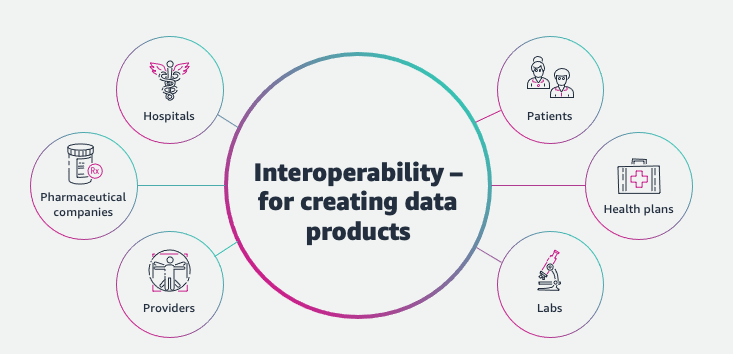
Medical institutions increasingly rely on interconnected medical devices and healthcare systems to collect, share, and analyze healthcare data. These network-connected systems transfer electronic health records, medical results, insurance claims, and other medical information across different healthcare departments. Healthcare interoperability allows healthcare professionals to collaborate toward better patient outcomes with prompt, reliable, and secure data.
Government
Interoperability supports sustainable administrative approaches that governments take to improve public service delivery. It allows various ministries and departments to implement data-driven policies through eGovernment or similar initiatives. Applying a shared data exchange framework also enhances government collaboration by overcoming interdepartmental differences.
Public safety
First responders, including police, firefighters, and paramedics, require timely and accurate information to render best-effort assistance in emergencies. Instead of operating with separate systems, they use interoperable systems to share and understand common data to coordinate responses in critical situations. In emergencies, the accuracy, cohesiveness, and efficiency of interoperable systems are crucial to the affected individual's safety and well-being.
Defense
Military forces use interoperable systems to support strategic missions, training, and inter-unit collaboration. Military operations require prompt and accurate propagation of intelligence from the chain of command. Armed forces from allied nations can also host joint military exercises aided by shared tactical intelligence that interoperability provides.
Software engineering
Software developers use the principle of interoperability to allow software applications built with different programming frameworks to interact seamlessly. They can build software or microservices that exchange data in real time without additional middleware or coding.
Machine learning
Artificial intelligence (AI) companies build deep learning models by training them with vast datasets, and integrate them with enterprise systems by APIs. Standardized model formats, like ONNX, allow machine learning engineers to run trained models across different inference solutions, which can reduce time-to-result and costs. Organizations and individuals can share training datasets with standardized formats.
What are the levels of interoperability?
Organizations can implement systems with four levels of interoperability. Each level builds on the previous, increasing your system's ability to exchange information and facilitate interoperability.
Foundational interoperability
Foundational interoperability describes computer systems that share data across a network but don't interpret that data. This forms a basic level of interoperable exchange of information among disparate systems, with electronic systems transmitting data. Usually, human intervention, such as manual data entry, is required to bridge the understanding gap between systems.
Structural interoperability
Structural interoperability, also known as syntactic interoperability, provides consistent data formats or structures interpretable by different systems. It allows systems to retrieve and interpret data from external sources for subsequent processing, as they all use common data formats or schemas.
By organizing data into predictable fields, you allow applications to process specific data elements quickly and correctly. Interoperable communications systems use this to let different devices process data regardless of their manufacturer.
For example, interoperability in HL7 v2 allows healthcare providers to share and access data securely and accurately across different departments.
Semantic interoperability
Semantic interoperability allows different systems to exchange information without human interpretation. This level of technical interoperability embeds information like metadata, code sets, and shared vocabularies alongside raw data to improve how it's read contextually.
Semantic interoperability is unambiguous and leaves no room for errors or misinterpretation. Semantically interoperable systems share the same conceptual understanding of what the underlying data conveys. When sharing electronic medical records, for example, semantic interoperability makes sure that all healthcare systems read and understand patient data in the same way.
Organizational interoperability
Organizational interoperability allows multiple systems to exchange interpretable data beyond their technical context, including across different governance policies. It aligns information systems on numerous aspects, including goals, workflows, and expectations unique to the organization. Organizational interoperability helps to provide strong data governance, collaboration, and information sharing across administrative and geographical boundaries.
It's especially important when multiple management systems and records management systems are involved in sharing data, as it brings a level of consistency across different administrative approaches and facilitates information exchange.
How does interoperability work in healthcare?
Healthcare interoperability is the effort to balance information availability and patient privacy in medical institutions by sharing data securely.
Healthcare providers implement health information systems that give diverse teams regulated access to patient data and other electronic health information. For instance, a doctor treating a patient in an emergency room can quickly pull up a diabetic patient's recent blood sugar tests from an affiliated clinic. They could also find a cardiogram from a visit to a partner cardiologist.
At the same time, medical providers must comply with privacy and security regulations enforced to safeguard patients' interests. This becomes crucial when organizations share data with external third parties for the advancement of medical research. The exchange of de-identified patient data, such as diagnostic information, genomic data, treatment regimens, and patient outcomes, is an example of this.

Interoperability in healthcare works through the implementation of several industry standards and acts. These promote the secure exchange of medical data between disparate systems. Here are some examples.
Vocabulary standards
Vocabulary or terminology standards represent specific agreements on terms, code sets, or descriptive representations that support health data interoperability among medical software systems. For example, the ICD-10 contains terminologies that describe symptoms, diseases, and complications.
Healthcare interoperability content standards
Content standards provide a data content framework for medical systems to represent health data with a mutually agreeable format. For example, HL7 is a messaging standard that defines electronic health information's data structure and semantics. This means all health software systems can interpret the data correctly.
Defining how to organize clinical and administrative data elements with this consistent approach across data formats lets healthcare organizations exchange data with other systems with ease. Many content standards support large-scale information exchange, including cross-organization health information exchange initiatives and public health reporting programs. For example, the fast healthcare interoperability resources (FHIR) standard builds on HL7 v2 and HL7 v3 standards with modular resources that make it even easier for real-time exchange.
Transport standards
Transport standards are drafted to enable health information technology solutions to send and receive data reliably. For example, Digital Imaging and Communications in Medicine (DICOM) allows different imaging machines to transmit imaging data to other systems in a healthcare facility.
Privacy and security standards
Privacy standards give patients authority over how healthcare organizations collect, store, and use their personal healthcare information and medical records. The Health Insurance Portability and Accountability Act (HIPAA) is a piece of legislation that regulates US healthcare providers' implementation of protective measures for sensitive data. For example, FHIR includes built-in security for data exchange to conform with HIPAA and help to ensure patient safety.
Health information identifier standards
Identifier standards are unique codes that allow networked computerized systems to identify a patient, medical professional, or healthcare provider. Example identifiers are Medical Record Numbers (MRNs) and National Provider Identifiers (NPIs). Hospitals use an enterprise master patient index (EMPI) to link patient identities in different medical departments using these identifiers.
How does interoperability work?
Every information system has unique hardware, software, functional, and operational specifications. To achieve interoperability, different systems must reach a certain degree of agreement when sharing data.
When building interoperable systems, engineers make sure that data can be exchanged electronically over the medium the systems are connected to. This might involve standardizing hardware communication, including protocol, data format, and networking technologies. Applying industrial standards helps determine how systems communicate within a similar context.
Once foundational interoperability is established, system engineers work towards a higher level of interoperable data exchange. To do that, they may define a shared knowledge base consisting of definitions that all connected systems refer to.
The knowledge base is a common truth that streamlines how the systems interpret information from external sources without additional data manipulation. In manufacturing, for example, semantic interoperability allows data collected from production floors to be shared consistently with inventory management and supply chain systems.
What are the challenges in interoperability?
Interoperability is critical to achieving the optimal information flow for operational and information systems in various industries. However, organizations need help overcoming several interoperability challenges and technical barriers to facilitate this effective data exchange.
Managing data at scale
Implementing interoperable systems needs a coordinated effort to consolidate data from multiple sources. Legacy systems store information in siloed databases and storage with incompatible formats. It takes skilled expertise, time, and compute resources to extract, clean, transform, and load massive amounts of disparate data sources into shared storage.
Moreover, organizations must avoid disrupting their operational workflow when transforming their data management strategies to support interoperability.
Addressing privacy concerns
Organizations must enforce security measures to safeguard information when they allow interoperability. Such efforts become complicated with multiple systems exchanging data through complex data pipelines. Therefore, organizations augment them with appropriate security technologies and policies.
Enforcing interoperability standards
Conventionally, organizations use systems that run with their respective customized protocols and data storage structures. A common industry standard is necessary to allow systems to communicate at a high level of interoperability. Even if interoperable standards are introduced, organizations must modernize their machines, software, and data infrastructure to permit data exchange between two or more systems.
Technical and organizational alignment issues
Interoperability refers to how systems and companies can work together, but achieving alignment in practice can be challenging. Many organizations want to move toward technological interoperability to connect their business to others and share content through standardized formats. However, if different companies use different interoperability standards, systems can fall out of alignment.
It is important to establish a clear interoperability definition as an industry, ensuring that all international standards organizations create consistent rulings for your sector. Healthcare and public safety interoperability are two fields that are consistently working towards this goal, with industry bodies promoting interoperability at the content, system, and organizational levels.
How can AWS support your interoperability requirements?
With AWS, you can design your own interoperability solution, or take advantage of AWS services that offer interoperability at the core:
- Amazon MQ is a managed message queue service for RabbitMQ and ActiveMQ that supports industry standards, including AMQP, STOMP, MQTT, and JMS.
- AWS HealthLake is a fully managed, HIPAA-eligible service that transforms fragmented healthcare data into a unified FHIR-based repository at petabyte scale.
- AWS IoT Core allows you to connect, manage, and scale your IoT device fleets easily and reliably without provisioning or managing servers, using the common MQTT protocol standard.
Get started with interoperability on AWS by creating an account today.
Next Steps on AWS
Browse all cloud computing concepts
Browse all cloud computing concepts content here:
Did you find what you were looking for today?
Let us know so we can improve the quality of the content on our pages