What is Cloud Networking?
- What is cloud networking?
- What are the types of cloud networking?
- What are the main benefits of cloud networking?
- How does cloud networking work?
- What's the difference between cloud networking and cloud computing?
- What are the challenges of cloud networking?
- How can AWS support your cloud networking requirements?
What is cloud networking?
Cloud networking is the use of cloud-based services to run a corporate network that connects an organization’s employees, resources, and applications. Traditionally, organizations used their own private network hardware components to create an isolated wide area network (WAN) for secure communication and application deployment. Setting up and managing the network was expensive and complicated. Cloud networking solves these challenges by allowing your organization to use virtual network components instead. A third-party cloud service provider manages and maintains networking hardware and infrastructure. This way, your organization’s network administrators can focus on efficiency and optimize configuration.
What are the types of cloud networking?
Companies can use different types of cloud networking, depending on how much flexibility, control, or isolation for security reasons they need in their cloud environments.
Public cloud
Public cloud networking is where all infrastructure is owned and run by public cloud providers. What this means is that all network resources are delivered as public cloud services through a shared cloud platform.
A public approach is rapid and easy to get started with, as you don’t have to maintain any physical infrastructure. If you need elastic resource scaling and quick provisioning, public cloud is a good choice.
Private cloud
Private cloud environments are where cloud network traffic is dedicated to a single organization. You can run a private cloud platform within company-owned data centers or through dedicated resources with a managed cloud service provider.
A private cloud offers you isolated network environments, letting you enforce stricter controls for sensitive data while still benefiting from the scaling, automation, and centralized cloud management.
Hybrid cloud
Hybrid cloud networking joins both public and private options with on-premises networks, letting your workloads move between environments when needed. Most often, businesses opt for a hybrid approach when they want to modernize to the cloud but can’t do so all at once. They can continue using on-premises data centers while increasingly taking advantage of more cloud features.
You’ll need to have secure internet connections and consistent traffic routing to ensure data flow remains accessible and reliable with a hybrid approach.
Multi-cloud networking
Multi-cloud networking is where you access networking services from several cloud providers at once. In practice, that means that your workloads are distributed across available clouds, which may improve access and meet differing internal and external requirements.
Although multi-cloud networking offers flexibility, you’ll have to carefully coordinate network traffic and understand specific platform policies to ensure you meet infrastructure and compliance needs.
What are the main benefits of cloud networking?
Cloud networking can improve efficiency, scalability, and security for your organization.
Efficient network management
Custom networking solutions with third-party telecommunications providers come with a high cost and significant resource overheads. You have to purchase new networking equipment and communicate with the third party for network changes, updates, or new satellite business sites.
With cloud networking, your organization’s administrators can work within cloud platforms, in software, to define new network solutions or change existing solutions. Network management becomes more streamlined and cost-efficient.
Increased scalability
Scalability helps your organization prepare for many possible future outcomes. You can be more agile in the deployment and decommissioning of IT services. Traditionally, bringing on new business sites required strategic network configuration and investment in physical infrastructure. Scaling in hardware can be expensive and slow.
With a cloud network, it’s possible to roll out a new site with a custom network configuration in hours instead of days or weeks. You can create direct, secure connections to organizational resources and sites in just a few steps. Similarly, you can bring sites offline and decommission networks just as quickly and easily.
Easier security
Virtual cloud network solutions have been created specifically for organizations to build their own secure networks with software. Cloud providers use cutting-edge infrastructure and highly secure physical network components to support their customers’ virtual networking. To enhance security further, you can use cloud networking security tooling and follow best practices in network configurations.
Improved monitoring and maintenance
While many physical networking solutions are managed and maintained by telecommunications companies, others require in-house physical management. Cloud-based networking removes the need for physical management and maintenance altogether. It gives your organization full visibility into traffic data across networks, accessible through a range of network management software tools.
Enhanced network performance with cloud-based networking
Cloud-based networking lets organizations improve network performance by optimizing how traffic flows between users, apps, and resources. Cloud platforms can dynamically route traffic to reduce latency and avoid any potential congestion issues.
Instead of running on physical hardware, the use of cloud infrastructure means businesses can use load balancing at scale. This leads to consistent performance, even for cloud-hosted applications accessed by multiple users in different environments and locations.
Support for hybrid and multi-cloud networking solutions
You can easily connect on-premises systems with resources from a public cloud, private cloud, or multiple clouds. A cloud approach gives you complete flexibility about where to run workloads while ensuring consistent network connectivity across your traffic.
By supporting both hybrid cloud and multi-cloud environments in this configuration, teams can integrate different cloud providers or existing resources without rearchitecting everything. More flexibility lets you adapt and evolve whenever your networking needs change.
How does cloud networking work?
Traditionally, a business either owns a server located on-premises or rents a server in a nearby data center. The business would purchase direct network links to the data center from office sites through a local telecommunications provider. Today, cloud networking configurations use cloud-based virtual servers in the region. These servers connect to office sites by using a cloud-based virtual private network and gateway.
Cloud networking is virtual network components, topologies, and configurations that run on a cloud provider’s physical networking infrastructure. You define and manage your networks as software. You can create your own virtual local area networks (LANs) and wide area networks (WANs) with cloud resources.
Virtualization
Cloud networking services are possible because of virtualization. With software, you can define network components such as virtual routers, virtual firewalls, virtual load balancers, and even full network layouts. This virtualization means that the only limits to the possibilities of cloud networking are the capacity and capabilities of the underlying physical infrastructure.
For instance, a cloud service provider can virtualize multiple streams on a network cable with a large capacity. Here, they can create several different virtual private network links operating on it and share the capacity. Providers define the logically isolated virtual links in software and offer different capacities in different service packages. The links may also have different capacities at different times for off-peak savings.
Virtual private clouds
An isolated cloud network where you deploy other cloud resources is known as a virtual private cloud (VPC). With a VPC, you define a virtual private cloud network and run networked cloud resources within its bounds. You configure internet-based remote access through a virtual private network and a software-defined gateway. A virtual private cloud is logically isolated from other VPCs and the internet. You can think of a VPC as your own virtual data center.
For instance, your organization can establish a subnet in a particular Amazon Web Services (AWS) Region and Availability Zone. You can add Amazon Elastic Compute Cloud (Amazon EC2) instances and other cloud services to it. You can also add another subnet with EC2 instances in a different Availability Zone, with network traffic shared between the two.
Hybrid cloud networking
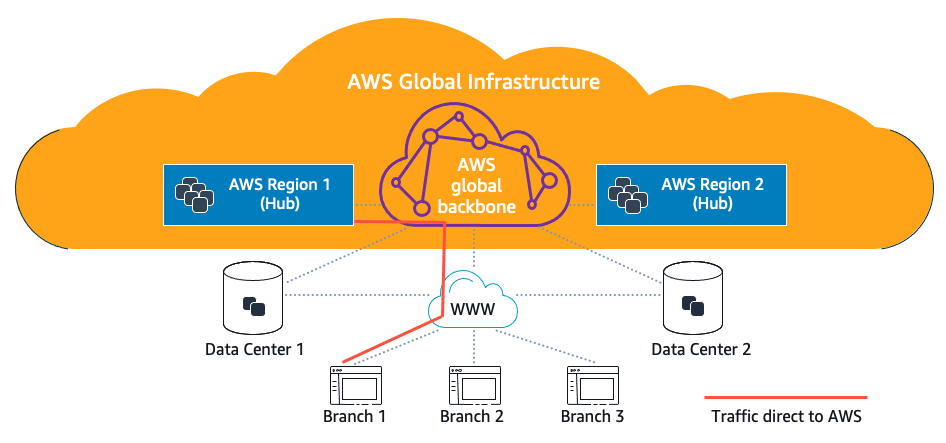
Within cloud networking, not all networking components and resources need to be cloud-based. For example, cloud networking configurations can connect to on-premises data centers and site branches through traditional networking infrastructure and the public internet.
What's the difference between cloud networking and cloud computing?
Cloud networking is just one cloud infrastructure component that’s available as a service from a cloud computing provider.
Cloud computing traditionally offers users access to a range of rented, virtualized IT infrastructure, such as servers, storage, and networking. A cloud provider owns and runs the underlying physical resources. These resources are offered as a service to customers through software-based management. The physical infrastructure itself is distributed across the world through virtualization. This means that multiple customers can run logically isolated private infrastructure on the same underlying physical hardware.
Cloud computing has now expanded beyond hardware-based infrastructure services to other products, such as tools and serverless computing.
What are the challenges of cloud networking?
Understanding what cloud networking is also means identifying and overcoming the challenges that you’ll likely encounter. While cloud networking does indeed simplify infrastructure, you still need to solve these challenges across cloud computing environments.
Vendor lock-in
Some cloud networking capabilities are specific to a particular cloud provider. When deploying cloud-based technologies and cloud-based resources across multiple data centers, it may be too costly or complex to migrate them to a different provider.
If you notice that a cloud networking solution doesn’t promote interoperability and has strict vendor lock-in policies, then it might be better to look for a more flexible solution. While a stricter vendor may provide short-term cost efficiency, this may cause issues later.
Limited control
In cloud networking, configuring networking logic typically happens within the control plane hosted by the provider, rather than being accessible to you. While this offers consistency, it limits how much you can directly interact with or configure underlying network resources.
If you need full control for security reasons or simply want to ensure efficient management, you’ll need a private cloud solution. Managing network resources at a granular level may not be accessible through public clouds.
Potential latency issues
Performance in cloud networking depends on whether traffic can move efficiently between end users and cloud servers. Especially for distributed solutions, with employees all over the world, ineffective data center or node placement can mean that systems connect users ineffectively.
Look for providers with a global presence to reduce the likelihood of latency issues. On a more granular level, you can use resource optimization strategies and use content delivery networks to reduce the physical distance between users and the services they’re trying to access.
How can AWS support your cloud networking requirements?
Amazon Web Services (AWS) cloud networking solutions help ensure your organization stays connected to the cloud, no matter where your sites and resources are. For example, you can use these solutions:
-
AWS App Mesh to provide application-level networking for all your services, with virtual routers for traffic handling.
-
AWS PrivateLink to privately connect virtual private clouds, supported AWS services, and your on-premises networks. With PrivateLink, you won’t expose your traffic to the public internet.
-
Amazon Virtual Private Cloud (Amazon VPC) to define and launch AWS resources in a logically isolated virtual network that you fully control for resource placement, connectivity, and security.
-
AWS Transit Gateway to simplify networks. You can connect Amazon VPC resources, AWS accounts, and on-premises networks to a single gateway.
-
Amazon VPC Lattice to consistently connect, monitor, and secure communications between your services, without adding networking complexity.
Get started with cloud networking on AWS by creating a free account today.
Browse all cloud computing concepts
Browse all cloud computing concepts content here:
Did you find what you were looking for today?
Let us know so we can improve the quality of the content on our pages